Commercial Landscape Lighting in the Lehigh Valley
Explore the benefits of low-voltage commercial landscape lighting in the Lehigh Valley, focusing on safety, durability, and thoughtful design for HOAs and offices.
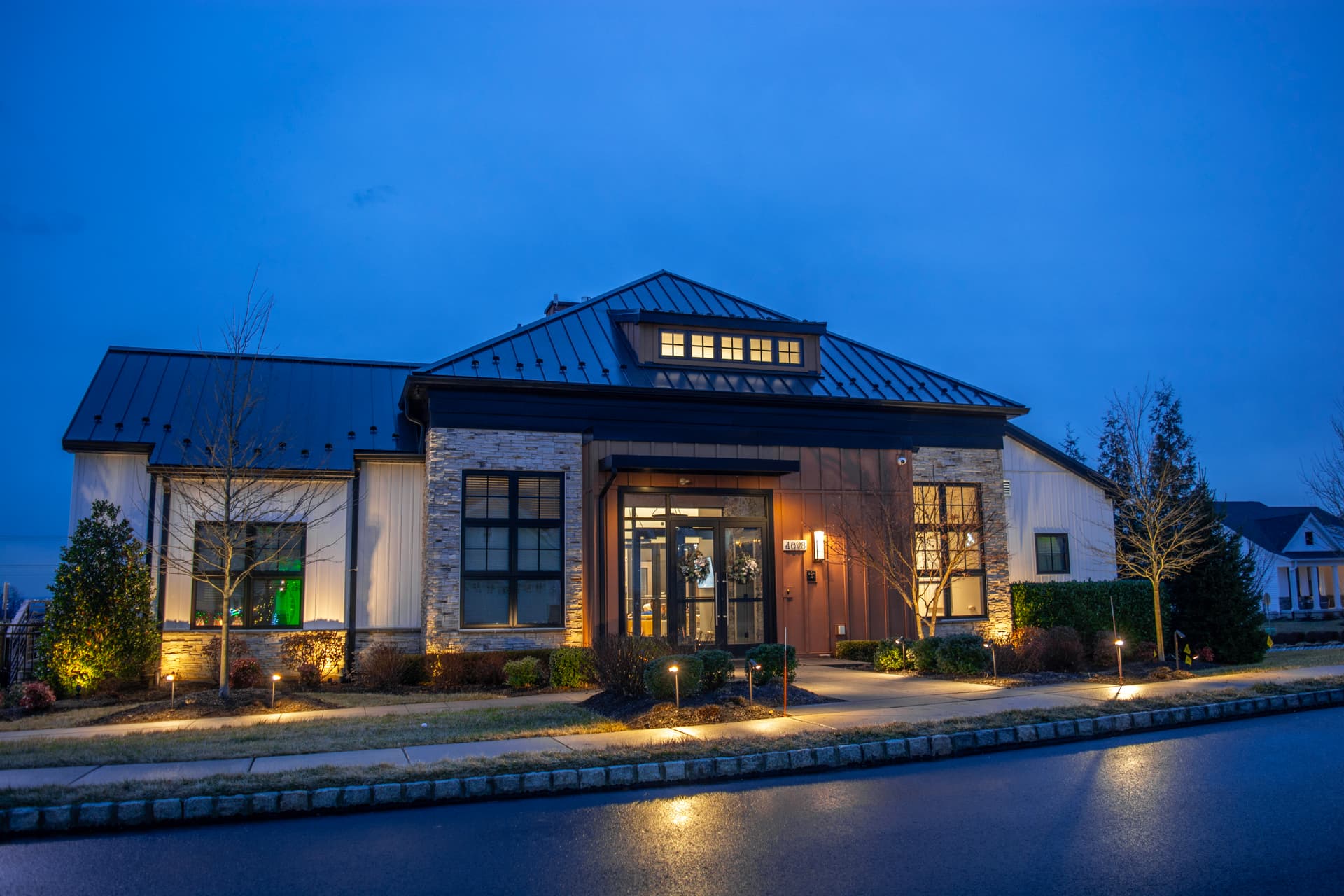
Exterior lighting on commercial and shared-use properties is rarely top of mind—until it becomes a problem. Walkways feel dim, entrances are hard to identify, and fixtures that once worked reliably begin to fail or fall out of place. Over time, these small issues add up, affecting safety, usability, and the overall impression of a property after dark.
Throughout the Lehigh Valley, many HOAs, offices, and commercial properties face these exact challenges. Low-voltage commercial landscape lighting offers a thoughtful way to address them, balancing safety, durability, and visual restraint rather than relying on excessive brightness.
Seeing Commercial Lighting Differently
A common issue on commercial sites is that exterior lighting evolves without a clear plan. A few fixtures are added here, brighter lamps are installed there, and over time the system becomes inconsistent. Some areas are overly bright, others remain shadowed, and glare becomes just as much of a problem as darkness.
Low-voltage landscape lighting approaches the problem from a design perspective. Instead of lighting everything equally, it focuses on how people actually move through a space. Walkways are clearly defined. Entrances are gently emphasized. Architectural elements help orient visitors without drawing attention to the fixtures themselves.
When done well, the lighting feels natural and intentional—present, but never distracting.
Why Low-Voltage Systems Make Sense for Commercial Properties
Although low-voltage lighting is often associated with residential landscapes, it is widely used in commercial environments when designed correctly. Its strength lies in control and flexibility.
Low-voltage commercial lighting allows for:
Directional light aimed exactly where it’s needed
Improved visibility without harsh glare
Lower energy use and operating costs
Safer electrical operation around pedestrian areas
Systems that can be expanded or adjusted over time
Rather than overpowering a property with brightness, low-voltage lighting supports how the space is meant to function after dark.

Lighting Walkways With Intention
Pedestrian pathways are one of the most critical areas on any commercial or HOA property. They guide residents, visitors, and staff between parking areas, buildings, and common spaces—often at night and in poor weather.
Traditional path lights frequently struggle in these environments. They can be too dim, poorly aimed, or easily damaged by snow removal and landscaping equipment. Over time, fixtures lean, break, or stop working altogether.
Directional path lighting with heavy-duty stakes provides a more durable and effective solution. By projecting light forward and onto the walking surface, these fixtures improve visibility while reducing clutter. Fewer fixtures are needed, and each one plays a clear role in guiding movement safely through the site.

A Local Example in Allentown, PA
One project that reflects this approach was completed at the clubhouse of the Regency of South Whitehall in Allentown.
The property’s existing lighting system had become increasingly ineffective. Overall light levels were too low, several fixtures were no longer functioning, and traditional path lights were frequently knocked over by snowblowers during winter maintenance. The primary concern was simple but important: it was difficult to safely navigate the walkway to the entrance after dark.
The solution focused on clarity rather than quantity. Brighter, directional path lights were installed to concentrate light directly on the walkway, guiding visitors naturally toward the door. In addition, a small number of architectural downlights were discreetly mounted on the building itself. These fixtures are barely noticeable, yet they add subtle depth and visibility around the entrance.
All of the lighting was tied into a single low-voltage system, creating consistency and reliability without drawing attention to the hardware.
Designing for Durability in the Lehigh Valley
Commercial lighting systems must withstand more than daily use. Snow, ice, landscaping equipment, foot traffic, and routine maintenance all place stress on fixtures over time—especially in northeastern climates.
Thoughtful low-voltage commercial lighting design accounts for this by emphasizing secure mounting, protected fixture placement, and durable materials. Instead of relying on many vulnerable fixtures, the focus is on fewer, well-placed lights that can perform reliably year after year.
The result is a system that continues to work quietly in the background, season after season.
Lighting That Supports How a Property Is Used
For HOAs and commercial properties, exterior lighting influences far more than appearance. It affects how safe a space feels, how easily people move through it, and how welcoming the property is after sunset.
Low-voltage commercial landscape lighting supports these goals without making a property feel over-lit or institutional. When the design is right, people don’t notice the fixtures—they simply feel more comfortable navigating the space.
Thoughtfully designed exterior lighting doesn’t try to overpower the night. It enhances what’s already there, guiding movement, improving safety, and allowing commercial properties to function with confidence long after dark.